
Customs tariffs: British Columbia businesses expect to suffer losses
One of the sectors that will be affected by the new U.S. tariffs is that of vineyards in British Columbia, according to the Canadian Federation of Independent Business.
Photo: Radio-Canada / Matisse Harvey
Published on August 22 at 1:12 PM PDTUpdated on August 22 at 6:02 PM PDT
Originally posted at: https://ici.radio-canada.ca/nouvelle/2277009/fermete-negociations-commerciales-canada-etats-unis
British Columbia companies whose products were subjected to 50% U.S. tariffs on Saturday are expecting significant revenue losses. Prime Minister David Eby has pledged to fight for them.
According to the Canadian Federation of Independent Business, 40% of Canadian small businesses are immediately affected by the new tariffs imposed by the Trump administration, and nearly a third of them anticipate a 50% drop in revenue.
Of all the provinces, British Columbia has the highest proportion of exports affected by the new round of tariffs, at 13.7%.
Open in full screen mode
British Columbia is the province most vulnerable to the new tariffs, according to Statistics Canada.
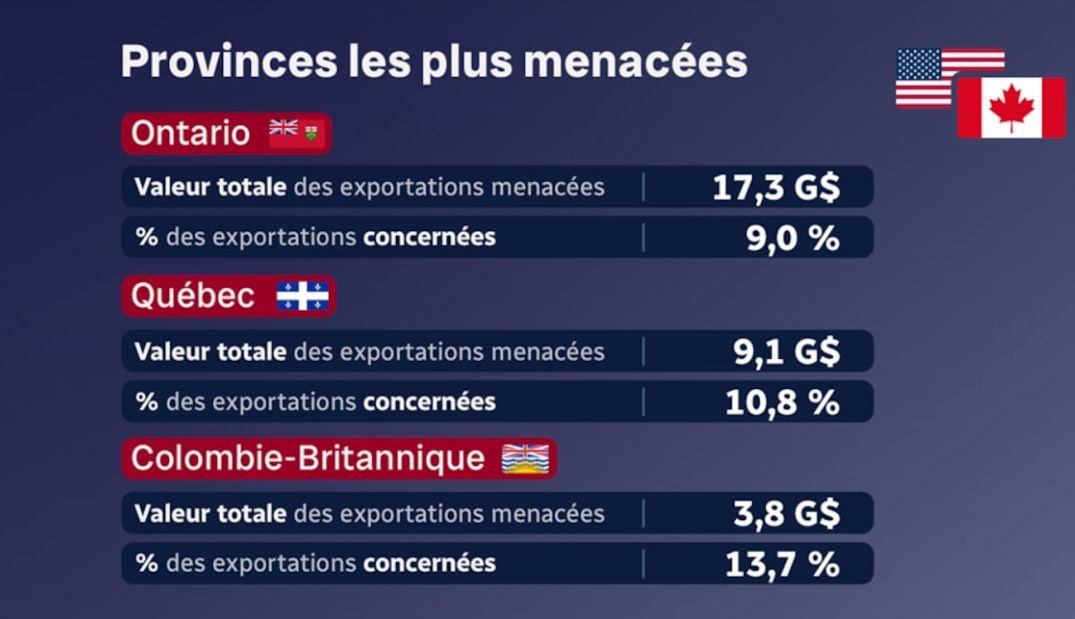
Photo: Statistics Canada
Several British Columbia companies are also worried about the retaliatory tariffs that Canada has promised to impose on American imports.
Advertisement
ELSEWHERE IN THE NEWS: Chris Kreider expects a "passionate" welcome at the Bell Centre
“We have people who bring in bolts from the United States and whose materials are shipped back there, and they make very frequent trips back and forth,” explains Cory Redekop, executive director of the Langley Chamber of Commerce, in suburban Vancouver. “It’s a double-edged sword.”
Nevertheless, Mr. Redekop says he understands Canada's desire to take retaliatory measures against its American neighbour: "We cannot let this happen," he says.
"We understand that, from a political standpoint, it is difficult for the Prime Minister [Mark Carney] not to impose retaliatory tariffs, but it will hurt Canadian businesses and, therefore, this is not a path that should be the long-term policy," said Jasmin Guénette, Vice-President of the Canadian Federation of Independent Business.
An agreement that met the demands of the American administration would have been even worse for the province's economy than the 50% tariffs, according to Samuel Roscoe, a professor of business education at the University of British Columbia.
"The way the negotiations were unfolding suggested very, very negative consequences for the Canadian economy in general," he added.
Advertisement
We must not give in to Trump the bully.
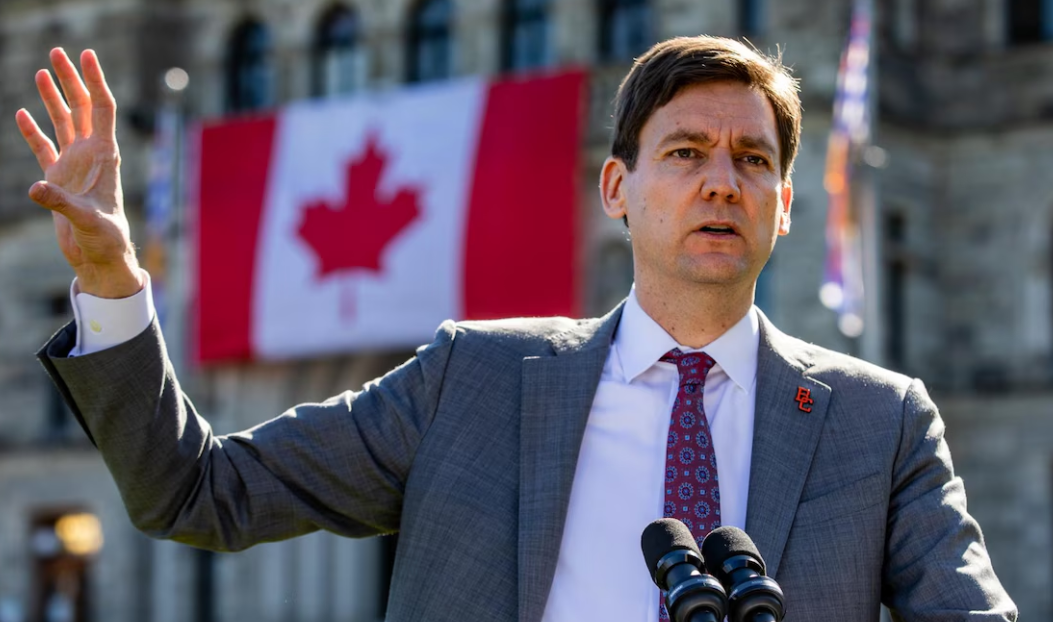
British Columbia Premier David Eby took a firm stance against U.S. President Donald Trump, whom he called a bully . "We have to stand up to him," Eby declared.
In this regard, David Eby indicated that liquor stores in British Columbia will continue not to sell American alcoholic products until the United States eases its tariffs on wood products from the province.
Continuing in the same vein, Mr. Eby said: Even Russian forest products currently have better access to the American market than Canadian forest products. In this context, the idea that we could sell American alcoholic beverages is absurd.
Open in full screen mode
David Eby adopted a firm stance towards the Trump administration. (Archive photo)
Photo: Radio-Canada / Mike McArthur
All the tools and weapons at the disposal of the federal government in this economic war waged against Canada are on the table for British Columbia.
A quote fromDavid Eby, Premier of British Columbia
British Columbia Conservative Party leader Kerry-Lynne Findlay is calling on Premier Eby to bring the crisis before the Legislative Assembly. "This is an economic emergency and requires an urgent response."
One positive point
Bridgette Anderson, president of the Greater Vancouver Chamber of Commerce, is also concerned about the losses that will be suffered by businesses in the province.
Nevertheless, she sees a positive side to the conflict: "It has forced British Columbia and Canada to get their affairs in order, that is, to diversify their trade, to examine it more closely, to develop their infrastructure and to move forward with major projects."
Garrett Senez, vice-president of Pacific Rim Distributors, a Canadian beer distributor based in North Vancouver, agrees: "I think this will allow us to obtain significant funding from the Canadian government to develop our international partnerships."