Craft Beer in Thailand - 2025 Market Report
KEY DATA FINDINGS
Total beer volume sales increase by 8% in 2024 to 2.2 billion litres
Craft beer continues to increase with localized proudction now available in 2025; many importers have exited the market.
Stout is the best performing category in 2024, with total volume sales rising by 25% to 1.7 million litres
Boon Rawd Brewery Co Ltd is the leading player in 2024, with a total volume share of 57%
Total volume sales are set to rise at a CAGR of 3% over the forecast period to 2.5 billion litres
2024 DEVELOPMENTS
Foodservice gains back sales and growth from local consumers and tourism in post-pandemic period
Beer saw volume sales increase in Thailand in 2024. On-trade is considered an important distribution channel for beer in the Thai market. Many brand-sponsored events such as concerts and festivals are held to generate awareness and sales, though this practice was dropped during the pandemic. Beer did not see the same dynamism in online sales replacing on-trade and store-based retail as other product categories because the weight and shipping fee was not considered worth the purchase compared to buying from nearby retailers. In 2024, the on-trade channel gained back volume sales as people returned to going out, tourism increased and festivals such as Songkran and New Year served to boost sales. Looking to raise brand awareness as consumers showed a reviving interest in beer for normal socialising, Heineken notably launched Heineken Experience Silver, a new fashion lifestyle brand, as it sought to connect with the new generation of young adults of legal drinking age through its “Let it Flow” attitude.
Nonetheless, despite ongoing recovery in the on-trade channel, on-trade volume sales of beer remained below the levels seen immediately prior to the COVID-19 crisis. This was in part due to the challenges presented by the macroeconomic environment, with high rates of inflation in the final two years of the review period putting pressure on consumers’ finances and discouraging discretionary spending, especially in areas such as out of home socialising.
Inflation caused unit price increase
2025 continues to see inflation, as we did in 2025 upon the return to normality in the wake of the pandemic; beer players decided to increase unit prices because of the impact of the high rate of inflation on their operations. The increase in production, shipping, and packaging costs such as for metal cans and glass bottles, which are directly correlated to the price of oil, were significantly impacted by the rise in global oil prices towards the end of the review period. These factors put pressure on companies to raise product prices, inevitably pushing the burden onto consumers. This came after manufacturers had worked not to raise prices during the COVID-19 crisis. The price of Leo glass bottled beer increased by around 3% in 2024, while Heineken increased its prices by 3-5% for both glass bottles and metal cans. In addition, Chang announced an increase in its prices by 2-3%. These price increases served to further deter already highly budget conscious consumers from directing their reduced spending power towards buying beer in either on-trade or off-trade channels.
Energy drinks player, carabao, enters beer market to compete with the major brewers
Boon Rawd Brewery Co Ltd and Thai Beverage PCL continued to jointly dominate the beer market in Thailand in 2024 nad very much so into 2025. However, they face a new rival in the form of Carabao Group (CBG), which launched two new beer brands into the market through NBO, Tawandang German Brewery 1999 Co Ltd. This move made the market more competitive and gained widespread attention. Previously, CBG was a key player in the energy drinks market, but in 2023, it decided to join the beer market with an investment of THB8,000 million. The goal is to win a 10% share of the beer market. The two brands are Tawan Daeng and Carabao. Tawan Daeng has three SKUs: Weizen, IPA and Rose, while Carabao offers two SKUs: a domestic eco lager beer and a stout. In addition, CBG has its own retail operations through CJ Supermarket and Took Dee, which provides it with an advantage in terms of the distribution of its beer brands.
PROSPECTS AND OPPORTUNITIES
Craft beer driving growth due to consumer preferences and adjustment to law
Craft beer has been gaining in popularity worldwide, including in Thailand. Both local and imported craft beer from Laos and Vietnam have gained in visibility and popularity in Thailand. The Thai beer market has been monopolised by a few players for a long time. However, new regulations have been introduced in Thailand, which are designed to strengthen quality control and ensure that both large and small producers of alcoholic beverages adhere to acceptable standards. Under the new regulations, which became effective on 2 November 2022, restrictions on the production of beer, which previously had to be at least 100,000 litres annually, were also removed. Microbreweries can now produce beer without a minimum quantity requirement up to a million litres annually. Meanwhile, large breweries must produce at least 10 million litres of beer annually and have a minimum of THB10 million in registered capital. Small producers and microbreweries now have the chance to grow, provided that their machinery and equipment adhere to public health regulations, environmental laws, and official standards. The new regulation should facilitate the development of smaller breweries in line with the international trend towards craft beer. In order to successfully apply for a licence to produce craft beer, the applicant must be a juristic person established under Thai law and Thai nationals must hold not less than 51% of shares in the operation.
Health consciousness rising amongst drinkers
With a global trend towards healthier lifestyles, there is a notable and ongoing consumer shift towards lower calorie and non-alcoholic beer options in Thailand. In response to customers’ shifting demand, many brands have started to offer more varieties catering to health conscious consumers, such as Bavaria 0%, Ottinger 0%, Heineken 0.0 Malt, Hopster HOP SODA, Hite Zero 0.00 Malt, and Asahi Super Dry 0.0% (ASD Zero) in the non-alcoholic segment and 89 CALS for consumers who are specifically looking to control their calorie intake. Nonetheless, despite the growth of non/low alcohol beer, which was boosted by the experiences of the pandemic when there was a ban on the sale of alcoholic drinks, sales of these products are expected to remain low over the forecast period. As such, the performance of non/low alcohol beer is unlikely to have a considerable impact on the overall beer category going forward. Most Thai consumers will continue to prefer regular beer that contains alcohol over beer that only offers the taste of regular beer, especially as more health conscious consumers have an expanding range of regular beers with a lower alcohol content to choose from.
However, low alcohol content and light version reformulations appear insufficient to remove beers' unhealthy image amidst the current consumer trend towards health conscious lifestyles. Consumers are likely to require further development and a more sophisticated offer that is better for their health, as well as one that provides a better look while drinking. Brewing techniques, lower alcohol content, and repackaging remain important innovations for gaining popularity, particularly with the younger generation of adults of legal drinking age, who are becoming the main target of imported brands.
Premiumisation as a key driver of beer sales growth in thailand
As disposable incomes rise and the number of tourists visiting the country increases, Thailand is expected to see a growing demand for premium and imported beers. The first half of 2023 saw imports rise by over a third, with key importers including the UK, France and Australia. The UK saw a particularly sharp rise in its imports to Thailand, with an increase of over 75% in 2024, while France saw less than 10% increase and Australia saw a small decline in import volumes.
Nonetheless, domestic lager accounted for the majority of market volume and value in 2024 and is set to continue to do so throughout the forecast period. Domestic lager brands such as Leo, Chang, and Singha are frequently consumed by local consumers across all channels. With its affordable price point and a better understanding of local preference, domestic beer is set to retain a strong consumer base in the Thai market. The expansion of domestic brands is also playing a role in the development of wheat beer, which is offering a new opportunity for producers to be stronger in retail channels. Wheat beer, which is perceived as a premium beer, has become more affordable because of the growing presence of local brands. One such example is Boon Rawd Brewery’s Snowy Weizen. The brand further strengthened its position after the launch of Snowy Wild Rosé at a much lower price than existing brands. Snowy Weizen has received positive feedback from consumers. With an increasing number of domestic brands and a growing consumer base, wheat beer is anticipated to fare well over the forecast period.
CATEGORY BACKGROUND
Lager price band methodology
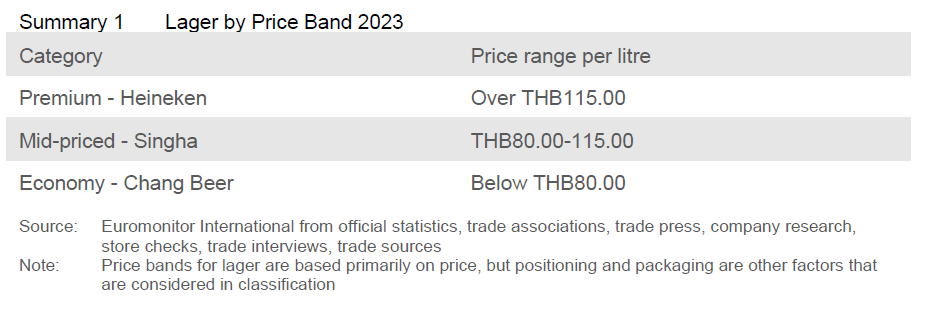
Economy lager is characterised by two local brands in 2025, Leo from Boon Rawd Brewery and Chang from Thai Beverage. Boon Rawd’s Singha dominates mid-priced lager, with San Miguel and Tiger being the only other brands with any significant sales. Premium lager is dominated by the international brand, Heineken.
Before the pandemic, Thai Beverage sought to establish a more upmarket image for its Chang brand, despite its economy positioning. This involved the use of more premium packaging formats, such as champagne bottles and seasonal labels.